NECT
NECT (Narrative Enhancement – Cognitive Therapy), is a group treatment to reduce self-stigma and is aimed at people with serious mental illness.
Training in NECT is provided as a two-day course.
✔️ Basic thoughts: One circumstance that can make it more difficult to recover and feel hopeful in the case of mental illness is that a person has come to believe that misconceptions about mental illness are true and apply to him or her. For example, that someone with schizophrenia cannot improve, cannot work, or experience a meaningful life.
🆘 NECT has priority 3 in the Swedish National Board of Health and Welfare's guidelines for schizophrenia, which means that the National Board of Health and Welfare states that it is a method that SHOULD be offered by the health and medical services and by the municipal social services. The research that exists is done on interventions for people with psychotic conditions, but there is good reason to believe that the intervention is also effective for other groups where self-stigma is a part, such as in cases of addiction or for relatives.
Content
The main parts of the NECT program are:
🌿 Teaching about stigma and self-stigma
🌿 Cognition and change strategies, and
🌿 Working with the story about yourself.

- An introductory part of two sessions introduces the program and creates a safe framework for what follows.
- Part of it, in three sessions, consists of psycho-pedagogical teaching about stigma, self-stigma, myths about mental illness and facts that debunk these myths. In addition, part that deals with the pros and cons of telling others that you have a mental illness.
- A part that is about seven sessions that deals with cognitive restructuring. That is, how one's own thoughts and feelings affect how one sees oneself and one's existence. And how these thoughts and feelings affect one's behavior. How can one change negative thoughts and feelings, for example through alternative ways of thinking?
- Another part of about seven sessions that deals with developing their personal history. Here, participants write down stories about their thoughts and experiences and read them out to the rest of the group, receiving feedback from the others. This can be a way to gain control over events and stories, to make them more understandable and to be able to place them in a time context.
- Finally, you have one session to summarize and conclude the training.
Links and other resources about NECT
🌎 The creators of the NECT methodology have an international overview website where you can find manuals in different languages, videos and links to NECT resources in different countries. The address is www.nectglobal.org
The National Board of Health and Welfare's central page on placing NECT with high priority in national guidelines You can find it here (in Swedish). 
The Swedish Public Health Agency has a knowledge portal about stigma and mental illness:
Materials and support in the area of stigma in mental illness and suicide
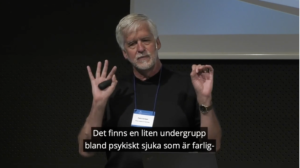
There you will also find videos from two lectures from a conference organized on stigma and mental health in 2019. The lectures are by Prof. Lars Hansson and Prof. Patrick Corrigan.
Experience and research
A larger RCT study (control group study with random allocation of participants to experimental group and control group) was conducted in Gothenburg and published in 2017; The effectiveness of narrative enhancement and cognitive therapy: a randomized controlled study of a self-stigma intervention .
The results showed that NECT is effective in reducing self-stigma in group participants. There are also other studies from the US and Israel on NECT that show similar results.
NECT, version for family members (in Swedish)
The working material is also available in a version that is adapted to function as a study circle on self-stigma for relatives of people with serious mental illness. The group sessions are then fewer, but longer, and the emphasis is slightly different.
This version has been tested (2021) with a group of relatives at a psychiatric clinic in Gothenburg and the experience was very good. Trials with such relatives groups are underway elsewhere in the country as well.
If you would like to know more about how to work with NECT for relatives, please contact us via the contact details on this page. It is also possible to arrange training in working with NECT for relatives.
The working material itself can be found here, for free download: NECT family workbook