
Course content
A training course in Interactive Interaction (IB) is, in its basic form, 3 full days and is held on-site. There are shorter courses that are held as digital live courses. The following parts are included:
☘️ An introductory section provides an overview of stress, mental health conditions, and cognitive function. We discuss both the circumstances and personal characteristics that can make it difficult to work with a person.
We agree on the meaning of terms such as disability, functional variation, stress, personality disorder, mental illness, neuropsychiatric disability, addiction/abuse, etc.
☘️ Another part concerns the practical/cognitive tools that can be helpful before, during, or after a conflict situation: techniques and strategies. What one actually says and does in different situations. What choices are available?
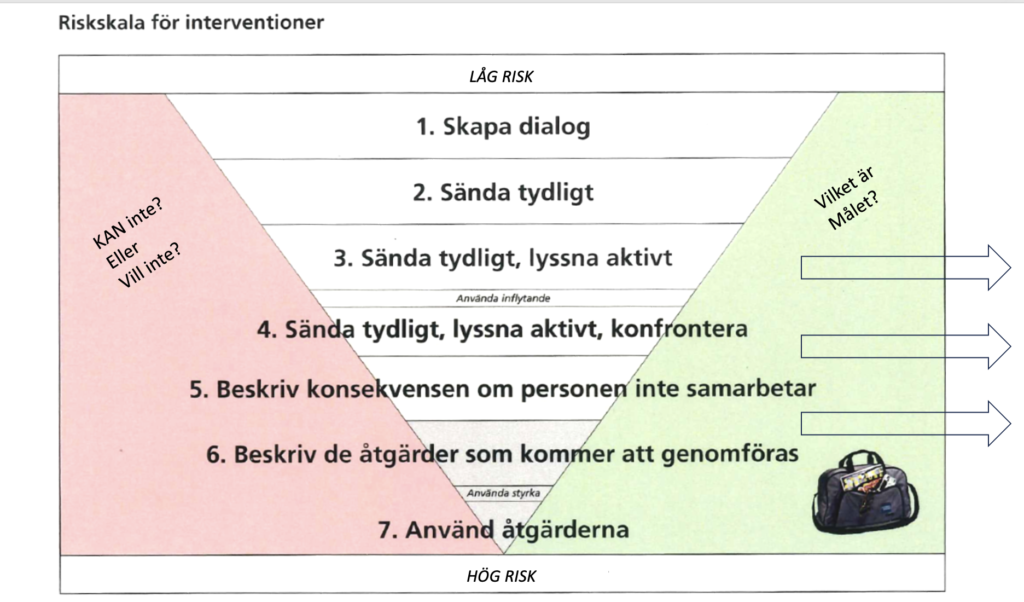
Please also take a look at the video from the webinar where the model, often referred to as the risk scale, is presented . It is available on this website, but also on YouTube, where you can make more settings yourself.
☘️. We also investigate the participants' own interaction problems, situations they have experienced themselves. have been involved in recently. These are presented in a simple format where the instructor helps the participant to make use of the analysis tools. The participant receives step-by-step guidance throughout the entire process.
☘️. Of course, we also discuss the classic elements of communication theory and psychology that deal with body language, facial expressions, eye contact, tone of voice, word choice, and other aspects, which are usually summarized as "non-verbal" and "paralinguistic" communication.
☘️. Other exercises allow participants to easily explore how they function in certain collaborative and conflict situations. These exercises are based on hypothetical examples, allowing participants to test behaviors without the pressure of a real-life situation. Feedback on one's own actions from other participants is usually a highly appreciated aspect.
The important thing is that the exercises teach you something that you can actually use when you encounter difficult situations at work. Experience shows that participants feel they have.
☘️. Finally, we want the participants to arrive at their own personal development goal during the course, one that they have decided on themselves. These are goals that relate to a real challenge they face.
☘️. Participants who have completed the course will receive a certificate of completion.